
HVAC Website Design in 2026: Why the Best Contractor Websites Are Tools, Not Brochures
Homeowners researching a new heating system have questions a brochure site cannot answer. The HVAC websites that win now answer them with working tools, load instantly on a phone and are written so Google and ChatGPT know exactly who to recommend.
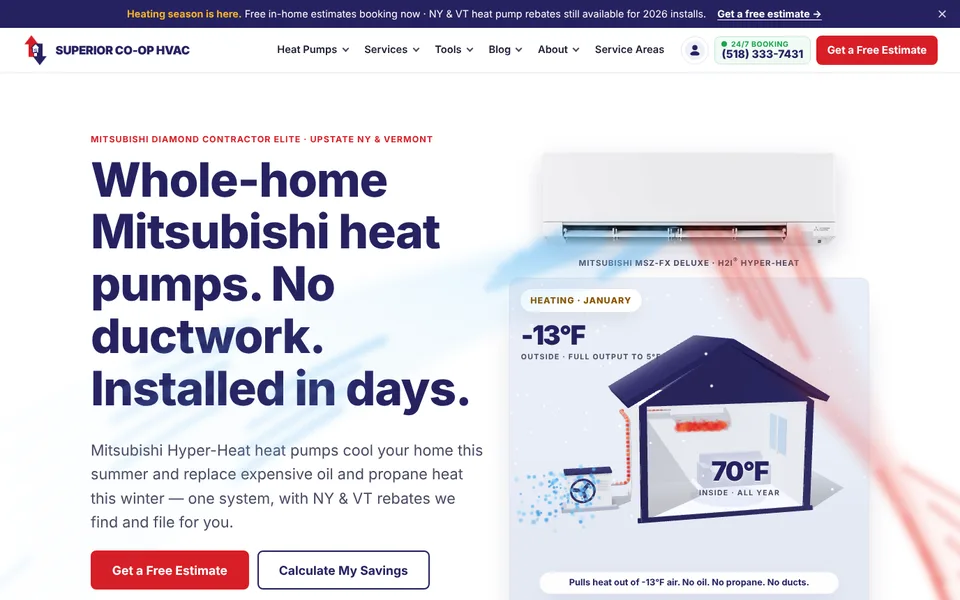
The short answer: The best HVAC contractor websites in 2026 are not brochures. They are working tools: a savings calculator, a room-by-room comfort diagnostic, a rebate qualifier, a service-area lookup, live 24/7 booking and a customer portal, all feeding one CRM. They load fast on a phone, have one page per service and per town, carry clean schema markup, and are written so that Google and AI assistants like ChatGPT can understand exactly what the company does and where. That is how we rebuilt scoophvac.com for Superior CO-OP HVAC, and it is the blueprint Media Pillars uses for HVAC websites everywhere.
What is wrong with most HVAC websites
Look at ten HVAC sites in any market and you will find the same page: a stock photo of a smiling technician, “Quality Comfort Since 1987,” a list of services, and a contact form. Every one of them says “honest, reliable, affordable.” Nothing on the page helps a homeowner make a decision, so the homeowner leaves to keep researching, and the site never gets a second chance.
A homeowner thinking about a new system has questions: What is my heat actually costing me? Will a heat pump work here? Which rooms are the problem? Do I qualify for a rebate? Do you even come to my town? A brochure site makes them call to find out. A tool site answers them and captures the lead while doing it.
The interactive tools an HVAC website should have
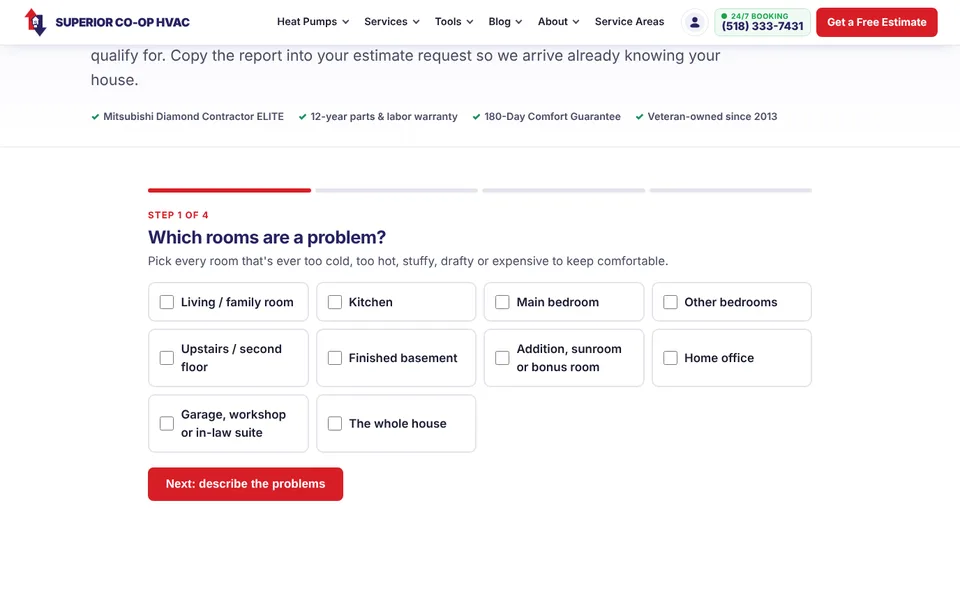
Each tool does double duty. For the homeowner, it is useful. For the company, it is a qualified lead with context: the rooms that are cold, the fuel they burn, the town they live in, the timeline they are on.
Page architecture: one page per service, one page per town
Google ranks pages, not websites. A single “Services” page listing furnace repair, AC installation, heat pumps, boilers and ductwork cannot rank for any of them. The structure that works for local HVAC companies:
- A hub page per service category, such as heat pumps or traditional HVAC.
- A dedicated page per service: furnace repair, central AC installation, boiler installation, ductless mini-splits, ducted heat pumps, maintenance plans, indoor air quality, emergency service, ductwork, oil-to-gas conversions.
- A town page for every market you actually want, written for that town rather than find-and-replaced. Superior has town pages from Albany to Lake Placid and into southern Vermont, each with local detail and the calculator as the call to action.
- Old thin pages consolidated into the new ones with 301 redirects so they stop competing with each other for the same search.
For heat-pump-focused contractors, every traditional service page carries a short “considering a heat pump instead?” section. You capture the furnace-repair search and present the upgrade path to the same visitor.
Speed: why we build HVAC sites as fast static websites
Most HVAC traffic is a homeowner on a phone, often standing in a cold house. Every second of load time loses some of them. scoophvac.com moved from WordPress to a hand-built static HTML site in 2026: no page builder, no plugin stack, nothing to hack and nothing to update every week. Pages load in a fraction of the time, and the interactive tools are standalone apps embedded where they belong.
Security matters here too. WordPress HVAC sites are frequent targets because they run dozens of plugins. We have cleaned up hacked contractor sites with injected gambling links and hidden admin accounts. A static site removes that attack surface entirely. We compared the two honestly in static HTML versus WordPress; if your team edits the site every week, WordPress still has a place, and we harden it properly.
Getting found in Google and in AI search
Homeowners now ask ChatGPT, Gemini, Perplexity and Google AI Mode “who installs cold-climate heat pumps near me?” and get two or three names back. Being one of those names takes the same fundamentals done thoroughly:
- Schema markup on every page: HVACBusiness, Service, FAQPage, BreadcrumbList, with the same name, address and phone as the Google Business Profile.
- An AI-friendly robots.txt that explicitly allows AI crawlers, and an llms.txt file summarizing who you are, what you do and where.
- Clear, specific answers on the page. Pricing ranges, equipment brands, warranty terms, service area and certifications written plainly enough to quote.
- Review velocity. Steady new Google reviews after paid jobs, which we automate (see the CRM automation post).
Search clicks are shifting. We showed real numbers in AI Overviews took half of a contractor’s search clicks: organic clicks fell sharply year over year while calls held up. Measure leads and booked jobs, not just traffic. Every site we build ships with Google Analytics 4 and Search Console connected and conversion events set up for calls, forms, calculator reports and bookings.
Conversion details that add up
- Two calls to action everywhere: “Get a free estimate” for the ready buyer, “Calculate my savings” for the researcher.
- A sticky mobile bar with call, text and estimate buttons.
- A 24/7 booking number in the header, shown openly as AI-answered.
- Trust signals near every decision point: manufacturer status, warranty, guarantee, years in business, real reviews.
- A seasonal announcement bar for what matters right now, like heating season estimate availability.
- One H1 per page, a clean heading structure and no duplicated copy between pages.
Does an HVAC website really need all of this?
Not on day one. A small shop can start with a fast, well-structured site with service and town pages, schema and live booking, then add the calculator before the next heating season. What matters is that each piece connects to the same CRM, so nothing a homeowner tells you on the website gets lost.
Website options and pricing
Media Pillars builds HVAC websites as fast static sites (our 24-hour website is the entry point) or as full multi-page builds with the town and service architecture above. Interactive tools and booking integration are added per company. All plan prices are on the pricing page, and you can see our HVAC-specific approach on the HVAC marketing page. Want to know where your current site stands? The free AI Visibility Check shows whether ChatGPT and Gemini recommend you, your Google Maps rank and your site speed in two minutes.
Part of our HVAC systems series: HVAC estimate software.
Screenshots are from scoophvac.com, Superior CO-OP HVAC’s live site. Disclosure: Media Pillars founder Frank Davis is also Sales & Marketing Manager at Superior CO-OP HVAC.
Frequently asked questions
What should an HVAC company website include?
Fast mobile pages, one page per service and per town served, clear trust signals, two calls to action (free estimate and calculate savings), live 24/7 booking, schema markup, GA4 and Search Console tracking, and interactive tools such as a heating cost calculator, comfort diagnostic, rebate qualifier and service-area map.
How do I get my HVAC company recommended by ChatGPT?
AI assistants recommend businesses they can find, understand and verify. That means specific service and town pages, schema markup matching your Google Business Profile, a robots.txt that allows AI crawlers, an llms.txt summary, consistent name, address and phone everywhere, and a steady flow of genuine reviews.
Is WordPress or a static website better for an HVAC contractor?
A static site is faster, cheaper to run and far harder to hack, which suits contractors who rarely edit their site. WordPress makes sense if your team edits pages every week, provided it is hardened and kept updated.
How many pages does an HVAC website need?
Enough to give every service and every target town its own page. A regional HVAC company commonly needs 40 to 100 pages, written individually rather than duplicated with the town name swapped.
Do interactive tools help HVAC SEO?
Indirectly and significantly. Tools earn longer visits, return visits and links, and they turn researching visitors into leads with context. The pages that host them also carry FAQ and WebApplication schema that search engines and AI assistants can read.
How much does an HVAC website cost?
Media Pillars publishes its website and monthly plan prices on its pricing page, starting with a 24-hour static website. Interactive tools and booking integrations are quoted per company after a walkthrough.
Does ChatGPT recommend your business — or your competitor?
Free 30-second check on ChatGPT, Perplexity and Gemini. Your score on screen, a PDF report in your inbox, and the exact fix.
See it answer a call before you decide
Call or text the AI line, or chat right here. It will book your 15-minute walkthrough on its own — that's the demo.