
How to Get Your Business Recommended by ChatGPT (2026 Guide for Local Businesses)
Step-by-step guide for local business owners: why ChatGPT, Gemini, Perplexity and Google AI Mode name some businesses and not others, how to get yours on the list, what it costs and how to check where you stand today.
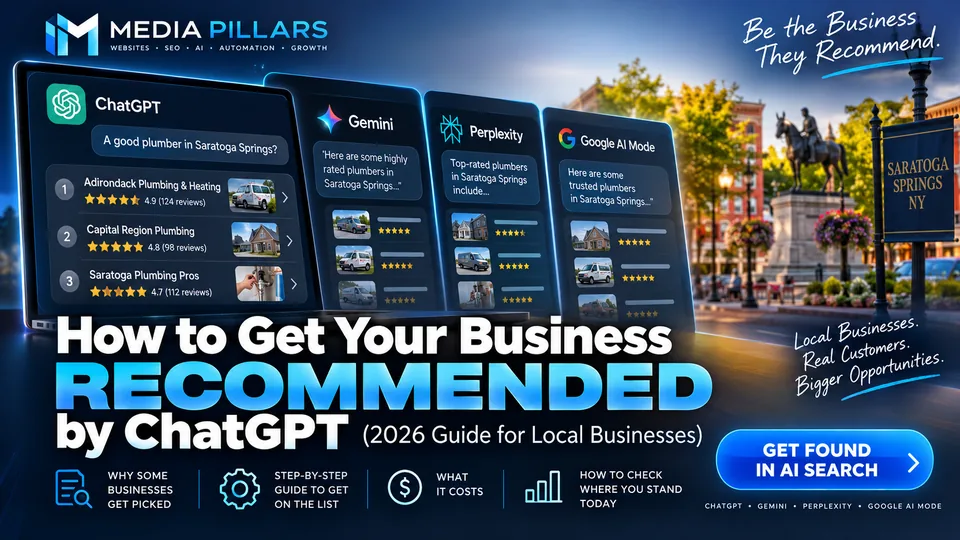
Ask ChatGPT, Gemini or Perplexity for “a good plumber in Saratoga Springs” and you get two or three names, not ten links. Google's AI Mode does the same thing. If your business is not one of those names, that customer never learns you exist. This guide covers how the assistants pick, why a well-reviewed business is often left out, and the exact steps to get on the list.
Everything here is what we do for clients in the AI Visibility programs, written out so you can judge it, do parts of it yourself, or hand it to us. If you want to know where you stand before reading, the free AI Visibility Check asks the assistants nine live questions about your industry and town and scores you in about two minutes.
How ChatGPT decides which businesses to recommend
An AI assistant is cautious in a way Google's ten blue links never were. A results page can show forty options and let the searcher sort them out. An assistant has to commit to two or three names and be right, so it favors businesses it can verify from several independent sources that agree with each other: the website, the Google Business Profile, review platforms and a handful of directories. Contradiction is disqualifying. Two phone numbers, three spellings of your name, or a service list that differs between your site and your profile all make you a riskier answer than the competitor whose facts line up.
The second thing it needs is a description it can quote. Assistants pull short, direct statements: “Smith Plumbing repairs and replaces water heaters in Glens Falls, Queensbury and Lake George.” They cannot do much with “We are committed to quality and integrity.” If your pages do not say what you do and where in plain words, the assistant has nothing to work with and moves on.
How do I get my business to show up in ChatGPT?
ChatGPT does not have a directory you can submit to and there is no way to pay for placement. It recommends businesses it can find, understand and verify from several sources that agree with each other. In practice that means five things: a complete and active Google Business Profile; a website that states plainly what you do and which towns you serve, one page per service; LocalBusiness, Service and FAQ schema on those pages; the same name, address and phone everywhere you appear online; and a steady flow of recent reviews. Do those five and you become the safest answer for the assistant to give.
Take them in that order. The Google Business Profile is the fastest-moving surface and the one every assistant checks first: right primary category, complete secondary categories, every service listed, service areas set, real photos, hours that are actually correct, and a response to every review. Then the website: one page per service, one page per town you seriously serve, each opening with a plain answer and ending with a short FAQ. Then schema, so the machines can read what the humans read. Then citations, so nothing contradicts. Then reviews, steadily, forever.
Why doesn't ChatGPT recommend my business?
When we run the free AI Visibility Check for a business that scores under 30, it is almost always one of three problems. The assistant cannot find a clear description of the services and towns, because the website talks about “quality and integrity” instead of “furnace repair in Glens Falls.” The Google Business Profile is half-filled or has fewer and older reviews than the competitors it names instead. Or the site has no structured data, so nothing can be verified and the assistant picks a business it can verify. A 4.7-star rating does not fix any of those, which is why well-reviewed businesses are often invisible to AI.
The sample report shows the most common pattern we see: a Glens Falls plumber with a 4.7-star rating and a score of 22 out of 100. The reviews were real. The assistants still named three competitors, because those competitors had complete profiles, service pages and schema, and the plumber had a homepage and a contact form.
How do I get found in Google AI Overviews and AI Mode?
Google AI Overviews and AI Mode are built on the same signals that rank you in Google Maps and organic search: your Google Business Profile with the right primary and secondary categories, recent reviews, one page per service and per town written in plain language, and schema markup on those pages. AI Mode additionally favors pages that answer a whole question in one place, with a direct answer near the top and a FAQ near the bottom. Search Console now reports AI Overview and AI Mode impressions, so you can measure it.
This is why we treat local SEO and AI search optimization as one program rather than two. The inputs overlap almost completely. A business that has done the profile, page, schema and review work properly tends to show up in the map pack, in AI Overviews, in AI Mode and in ChatGPT at the same time, and one that has not tends to be missing from all four.
What is AI search optimization, and is it the same as GEO, AEO or LLM optimization?
Yes, they are the same job with different labels. Generative engine optimization (GEO), answer engine optimization (AEO), LLM optimization and AI SEO all mean making your business the one ChatGPT, Perplexity, Gemini, Google AI Overviews and AI Mode name when a customer asks who to call. Media Pillars calls it AI search optimization. Whatever an agency calls it, ask what they actually change on your profile and your pages, and how they measure whether the assistants name you afterward. Our plain-English guide to LLM optimization goes deeper on what actually changed and why.
The one file most local businesses are missing
Newer AI crawlers look for a plain-text summary of your site at /llms.txt: who you are, what you do, where, and links to the pages that matter. It takes an hour to write and removes the guesswork for every assistant that reads it. Beyond that, make sure nothing on your site blocks the crawlers that feed the assistants. A surprising number of security plugins and robots.txt files quietly block them, and a business that cannot be crawled cannot be recommended. Our earlier article covers the five signals in more detail.
How much does AI search optimization cost?
At Media Pillars, the standalone AI Visibility programs are $597, $997 and $1,497 a month, each with a one-time $497 audit and setup, month to month with no contract. If you also want the phone answered and booked, the Get Found Everywhere plan at $897 a month includes the Foundation program, Market Leader at $1,297 includes Growth, and Market Leader Plus at $1,797 includes Domination. Every price is published on the pricing page.
How long does it take to get recommended by ChatGPT?
Google Business Profile and schema fixes usually show in AI answers within 30 to 60 days, because the assistants re-check public sources continuously. Content and review work compounds over three to six months. We re-run ChatGPT, Perplexity and Gemini for every client monthly and report whether you were named and who was named instead, so you see the change rather than take our word for it.
Where to start today
Run the free AI Visibility Check. It asks ChatGPT, Perplexity and Gemini nine customer-style questions about your industry and town, scores you from 0 to 100, lists the competitors named instead, and checks your Google Business Profile, Maps position, page speed and schema. The report tells you which of the three problems above is yours and what to fix first. If the score is good, we will say so. If it is not, you will know exactly what the work is before you spend a dollar.
Does ChatGPT recommend your business — or your competitor?
Free 30-second check on ChatGPT, Perplexity and Gemini. Your score on screen, a PDF report in your inbox, and the exact fix.
See it answer a call before you decide
Call or text the AI line, or chat right here. It will book your 15-minute walkthrough on its own — that's the demo.